Why Keyword-Based Patent Search Is No Longer Enough
Introduction:
Boolean logic, classifications, and carefully selected phrases were the foundation of systems such as Espacenet and Google Patents. Because domains were simpler to define and patent terminology was rather consistent, this worked successfully for decades. However, innovation is more complicated and happens more quickly now. Different sectors frequently describe the same invention in entirely different ways, and patent language varies greatly, ranging from extremely technical to purposefully broad legal jargon. It may be challenging to find older patents using current search phrases since they include antiquated vocabulary. Additionally, keyword-based approaches are increasingly failing to capture pertinent prior art due to the problem of millions of patents being stored across jurisdictions and languages.
Limitations of Keyword Search:
Traditional retrieval depended on: (i) Boolean operators, (ii) IPC/CPC classification systems, and (iii) Manually designed queries. Its strengths included high precision when the terminology was known, clear logic, strong legal support, and effective retrieval of known items.
- Modern innovation exposes major weaknesses: The patent domain actually made up hundreds of highly technical and specialised subdomains; each with its own very specific terminology and ontologies, finding and expanding trustworthy lexical resources is extremely challenging. The solution is correctly identifying, extracting, and connecting ambiguous concepts to an established ontology.
- Synonym & Terminology Gap: The same invention may be described as “autonomous vehicle,” “self-driving system,” or “intelligent mobility platform.” Keyword systems often miss these conceptual overlaps.
- Noise Overload : Broad searches can return thousands of irrelevant documents.
- Cross-Language Barriers : Variations in translation and industry jargon hide relevant prior art.
- Hidden Prior Art Risk : Missing critical patents increases invalidation risk, litigation exposure, and incomplete freedom-to-operate analysis.
How AI Changes the Paradigm:
Artificial intelligence causes the emphasis to change from words to meaning. Rather than precisely matching phrases, AI-driven systems analyse:
- Semantic contextAI models' inventiveness can automatically provide precise and superior content for semantic interpretation.
- Technical similarity Terminology used to describe modern inventions is rarely the same. It is possible for the same technical idea to exist in several patents utilising entirely different terminology, domains, or structures. Keyword-heavy processes are not the way of the future for patent search.
- Inventive intent In order to control overlaps, inventive purpose determines the fate of the aesthetic aspects of invention.
Technologies that facilitate this shift include: (i) Natural Language Processing (NLP), (ii) Semantic Embedding’s & Vector Search, and (iii) Large Language Models (LLMs)
This means AI can identify patents that are conceptually related even when terminology is entirely different. These tools uncover hidden connections, improve cross-language retrieval, and accelerate discovery. Semantic AI reveals overlaps, trends, and competitor activity that keyword searches often overlook.
Benefits of Semantic and AI-Powered Search:
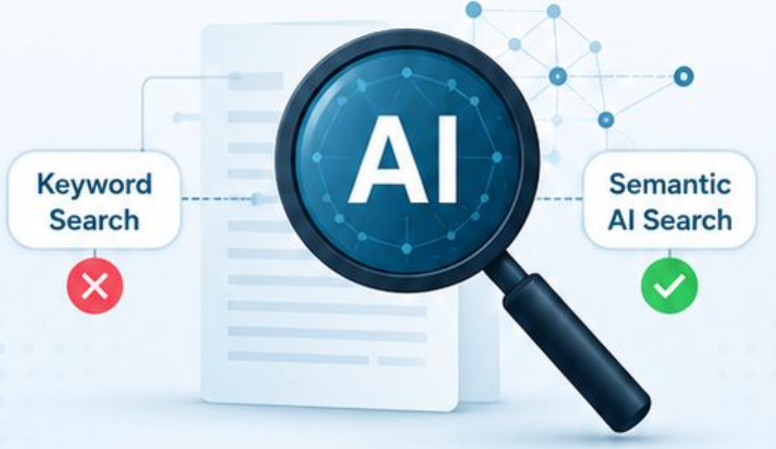
AI-Powered semantic search greatly beats conventional keyword-based search in patent workflows
- Discovery of Hidden Connections AI uncovers prior art that keyword searches miss, revealing overlaps and competitive activity.
- Better Cross-Language Retrieval Semantic systems bridge terminology gaps across countries and industries.
- Higher Recall with Balanced Precision Instead of missing relevant patents, AI expands the net while filtering noise intelligently.
- Faster Discovery What once took weeks of manual refinement can now be achieved in minutes with AI-assisted retrieval.
- Strategic Insights Beyond prior art, semantic search reveals emerging trends, rival strategies, and adjacent technologies.
Case Examples:
- Autonomous Vehicles: Traditional keyword searches might miss patents describing "robotic mobility platforms." AI semantic search connects these concepts, ensuring comprehensive coverage.
- Biotechnology: A gene-editing invention may be described differently across jurisdictions. AI links CRISPR-related patents even when terminology varies.
- Consumer Electronics: Wearable devices may be called "fitness trackers," "health monitoring bands," or "smart wrist devices." AI recognizes them as conceptually similar.
The Future of Patent Search:
A hybrid approach to patent search is emerging:
- For accuracy and legal defensibility, Boolean and Classification searches are still useful.
- AI semantic search improves conceptual discovery, recall, and cross-linguistic coverage.
- Context, judgment, and strategic interpretation are guaranteed by human expertise.
When combined, these strategies build a more robust and efficient patent search circumstance. Faster invention cycles and stronger patent portfolios are made possible by AI-driven patent search, which represents a shift toward data-driven intellectual property strategy. In the future, patent specialists will employ legal reasoning and strategic judgment, while AI will handle data analysis and pattern recognition.
Conclusion:
Patent search is entering a new era. Keyword-based methods alone can no longer keep pace with the complexity of modern innovation. AI technologies revolutionize the process by helping computers understand meaning behind words and detect conceptual similarities. The future lies in a hybrid approach combining Boolean and classification searches with AI-driven semantic search and human expertise.
How IdeationIP Helps?
At IdeationIP, we specialize in advanced patent searching that goes beyond keywords. By combining traditional methods with AI-powered semantic tools, we uncover hidden prior art, reduce litigation risks, and deliver comprehensive freedom-to-operate analyses. Our expertise ensures that clients gain a complete, accurate view of the patent landscape saving time, strengthening IP strategy, and enabling smarter innovation decisions.
We provide a full suite of services:
- Prior art searches
- Novelty assessments
- Invalidity searches
- Freedom-to-operate (FTO) analysis
- Patent landscape studies
- Competitor monitoring
- Strategic IP portfolio guidance
By combining AI-driven efficiency with expert analysis, IdeationIP delivers patent research that is faster, broader, and more reliable—directly addressing challenges of scale, complexity, and accuracy.