Patent Analytics in Semiconductor Innovation
Introduction
The semiconductor industry is characterized by rapid technological advancement, intense competition, and substantial investment in research and development. In this dynamic environment, patents play a critical role in protecting technological innovations and establishing competitive advantage. However, the large and continuously expanding volume of semiconductor-related patent information makes it increasingly difficult for organizations to identify meaningful trends, assess competitors, and make informed innovation decisions. Patent analytics provides a systematic approach to addressing this challenge by transforming patent data into actionable technological and strategic insights.
Semiconductor Innovation
Semiconductor innovation means creating faster, smaller, and more energy-efficient computer chips by improving their design, materials, and manufacturing. This progress drives modern technology forward, powering everything from everyday smartphones and electric cars to large artificial intelligence systems.
Patent analytics in semiconductor innovation is the systematic use of patent data such as patent applications, grants, citations, inventors, assignees, technology classifications, and patent families to analyze technological trends, innovation activity, competitive positioning, and intellectual-property risks within the semiconductor industry.
By combining patent analytics with technological and market intelligence, semiconductor companies can identify opportunities for innovation, anticipate competitive developments, avoid potential patent conflicts, and support strategic investment decisions. Thus, patent analytics has evolved from a purely intellectual-property management tool into an important component of semiconductor innovation strategy.
Landscape Approach on Semiconductor Innovation and Patent Analytics
Semiconductor innovation is evolving rapidly, driven by various technology platforms. Below data shows insights into a landscape view with data-driven sections on publications, filings, assignees, and geography.
Publication Trends and Filing Trends:
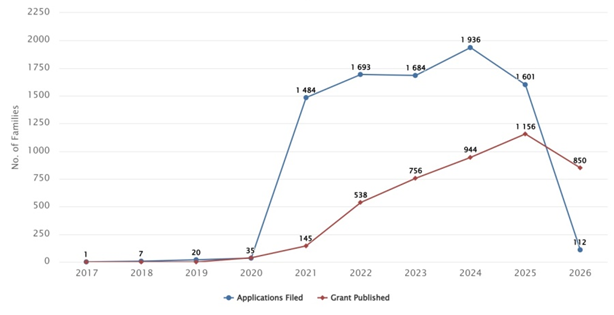
Insights: Applications filed rose sharply from 35 in 2020 to a peak of 1,936 in 2024, before dropping to 112 in 2025; and Grants published increased steadily from 145 in 2021 to 1,156 in 2025, then declined to 850 in 2026.
Top Assignees
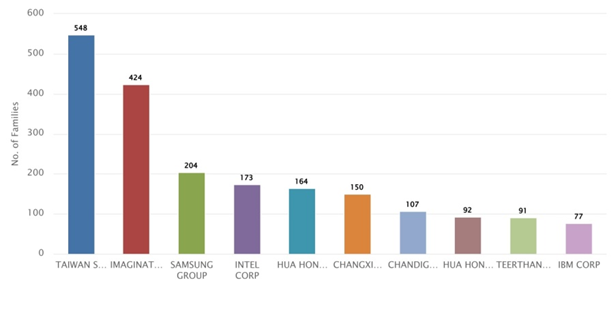
Insights: Taiwan Semiconductor (548 families) has the highest number of patent families, followed by Imagination (424), indicating a substantial lead over the remaining companies. The remaining companies range from 204 to 77 families, with Samsung (204) and IBM (77) marking the upper and lower ends of this group.
Technology Trend – Top Assignee vs. Industry
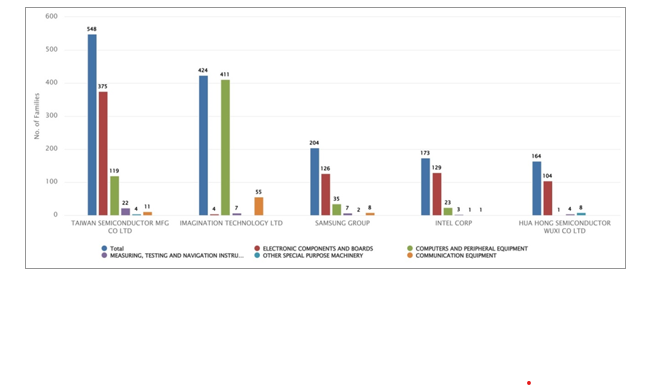
Insights: Taiwan Semiconductor leads with 548 patent families, followed by Imagination Technology (424) and Samsung (204), with most portfolios concentrated in electronic components/boards and computing equipment. Furthermore, Imagination stands out for its strong concentration in computers & peripheral equipment (411 families), while the other companies show more diversified technology-category portfolios.
Geographical Landscape in Semiconductor Patent Filings
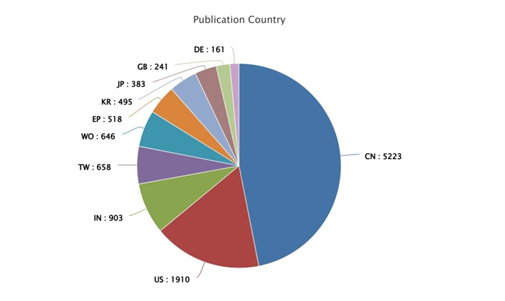
Insights: China dominates publication activity with 5,223 publications, substantially ahead of the US (1,910) and India (903). Taiwan (658), WO (646), and EP (518) form the next tier, while Germany has the lowest count among the listed jurisdictions at 161.
Key Areas of Semiconductor Patent Analytics
- Technology intelligence: Identifying emerging areas such as advanced nodes, FinFET/GAA architectures, chiplets, 3D packaging, AI accelerators, memory technologies, and semiconductor materials.
- Competitor analysis: Comparing companies such as chip manufacturers, foundries, equipment suppliers, and IP providers based on their patent portfolios.
- Innovation trend analysis: Tracking increases or decreases in patenting activity to identify growing or declining technology domains.
- Patent quality and influence: Evaluating citations, family size, geographic coverage, and other indicators to distinguish potentially influential patents from routine filings.
- Freedom-to-operate and risk assessment: Identifying third-party patents that could create potential barriers or infringement risks for a new semiconductor technology.
- White-space analysis: Finding technological areas with relatively limited patent activity where new R&D or innovation may have greater strategic potential.
- R&D strategy: Using patent evidence to guide investment decisions, partnerships, licensing, and technology development.
- New Materials: Using alternative substances beyond traditional silicon to handle heat and electrical flow better.
- Advanced Packaging: Connecting multiple specialized microchips together inside a single small unit for high performance.
Future Trends in Patent Analytics in Semiconductor Innovation
Patent analytics is expected to become increasingly important in guiding semiconductor research, intellectual-property strategy, and technology investment.
- AI-Driven: Future systems will move beyond simple patent counts and citation analysis toward AI-driven, predictive, and real-time intelligence.
- ML and LLM: Machine learning and large language models will help identify emerging technologies, hidden relationships among patents, and potential technology gaps by combining patent data with scientific publications, market information, and industry intelligence.
- Advancement: Analytics will increasingly focus on advanced process technologies, chiplets, advanced packaging, silicon photonics, AI accelerators, high-bandwidth memory, and sustainable manufacturing. These areas are becoming strategically important as AI-driven computing reshapes semiconductor demand.
- Predictive patent landscaping: Instead of merely describing existing patent portfolios, analytics tools will forecast technology trajectories, identify potential competitors, detect white spaces, and support freedom-to-operate and licensing decisions. AI-based semantic and graph analysis is already being explored for technological opportunity discovery.
Finally, patent analytics will become more global and ecosystem-oriented, helping companies monitor cross-border innovation, supply-chain risks, collaborations, and competitive positioning. As semiconductor technologies converge with AI and other emerging fields, integrating patent intelligence with broader innovation data will be essential for faster and more informed R&D decisions.
Core Trends and Technologies
- Advanced Packaging & 3D Integration: Tracking shifts toward chiplets and heterogeneous integration.
- Nodes and Miniaturization: Monitoring patents for sub-2nm gate-all-around (GAA) architectures and extreme ultraviolet (EUV) lithography.
- AI and Specialized Chips: Analyzing the surge in patents for NPUs, GPUs, and domain-specific accelerators.
- Wide Bandgap Materials: Mapping innovations in Silicon Carbide (SiC) and Gallium Nitride (GaN) for power electronics.
Challenges and Limitations of Semiconductor Innovation
- High technical complexity: Simple keyword searches often fail to capture concepts like FinFET/GAA structures, lithography, interconnects, chiplets, 2.5D/3D packaging, memory architectures, and EDA techniques.
- Patent thickets and overlapping claims: A single semiconductor product can involve thousands of patents covering different layers of the technology. Determining which patents are genuinely essential, overlapping, or strategically important is challenging.
- Standard-essential patents (SEPs): Technologies such as wireless connectivity, memory interfaces, and high-speed interconnects can involve standards. Determining whether a patent is actually essential to a standard—and assessing its licensing significance—is complex.
- Global patent landscape complexity: Semiconductor companies operate globally, requiring analysis across jurisdictions with different examination practices, legal standards, continuation/divisional strategies, and publication timelines.
- Patent-family and ownership ambiguity: The same invention can appear through multiple applications, continuations, assignments, subsidiaries, acquisitions, and joint ventures. Consolidating patents to the ultimate corporate owner is a major data challenge.
- AI-generated and AI-assisted inventions: As AI becomes part of semiconductor R&D, questions around inventorship, ownership, disclosure, and the identification of AI-assisted innovation will complicate future patent landscapes.
- Linking patents to actual products: One of the biggest challenges is establishing the relationship between a patent and a commercial chip, fabrication process, equipment platform, or software tool. Product-to-patent mapping requires substantial technical expertise.
- Predicting future innovation: Historical patent activity does not necessarily predict where the next breakthrough will occur. Analytics needs to incorporate scientific publications, standards, investment activity, hiring, startups, supply-chain movements, and technology roadmaps.
- Competitive intelligence and strategic interpretation: The real value lies not simply in identifying who owns patents, but in answering questions such as: Where is a competitor investing? Which technologies are becoming crowded? Where are white spaces emerging? Which patents could create licensing or litigation risks?
Conclusion
As the semiconductor industry navigates atomic-scale miniaturization, complex 3D architectures, and the global race for specialized AI silicon, innovation can no longer rely on guesswork. Patent analytics has shifted from a reactive legal safeguarding mechanism to an indispensable navigational compass for R&D leaders and corporate strategists.
By extracting intelligence from patent filings, geographic distributions, and technology overlaps, organizations can de-risk multi-billion-dollar fabrication investments, pinpoint uncrowded technological white spaces, and preemptively resolve freedom-to-operate barriers. Ultimately, the market leaders of tomorrow will be the enterprises that bridge high-velocity IP analytics with actionable, forward-looking commercial strategies.
How IdeationIP Can Help
At IdeationIP, we bridge the gap where AI's speed meets human judgment. Our advanced AI tools scan global databases quickly, while expert analysts interpret results with legal and strategic precision. This ensures innovators avoid wasted filings, identify risks early, and gain actionable insights into competitor landscapes.
We provide a full suite of services:
- Prior art searches
- Novelty assessments
- Invalidity searches
- Freedom-to-operate (FTO) analysis
- Patent landscape studies
- Competitor monitoring
- Strategic IP portfolio guidance
By combining AI-driven efficiency with expert analysis, IdeationIP delivers patent research that is faster, broader, and more reliable—directly addressing challenges of scale, complexity, and accuracy.