Patent Landscape Trends in Generative AI Technologies
Introduction
Generative Artificial Intelligence (GenAI) is one of the fastest-growing areas of artificial intelligence, enabling the creation of text, images, audio, video, software code, and scientific content. Technologies such as Large Language Models (LLMs), diffusion models, Generative Adversarial Networks (GANs), and multimodal AI are driving rapid innovation across industries. As investment and competition in GenAI continue to increase, patent activity has grown significantly across different technologies and application areas.
Generative AI Technologies
- Large Language Models (LLMs): LLMs use large-scale training data and advanced neural-network architectures to understand and generate human language.
- Generative Adversarial Networks (GANs): GANs use generator and discriminator networks to produce synthetic data.
- Diffusion Models: Diffusion models generate content by progressively transforming noise into structured outputs.
- Multimodal AI: Multimodal systems combine different data types within a single AI system.
- Retrieval-Augmented Generation (RAG): RAG combines generative models with external information retrieval. Patent opportunities may include retrieval mechanisms, knowledge integration, contextual generation, enterprise search, and domain-specific knowledge systems.
- AI Agents: AI agents combine generative models with planning, reasoning, tool use, memory, and task execution.
Patent Landscape of Generative AI
Patent landscape analysis of GenAI involves systematically identifying, classifying, and analyzing patent information related to generative models and their applications. A GenAI patent landscape can provide insights into:
- Patent activity and trends
- Patent activity and trends
- Technology trends
- Geographic activity
- Applications
- White spaces and opportunities
- IP and competitive intelligence
Current and Emerging Patent Landscape Trends
- Growth across the AI Value Chain: GenAI patent activity extends beyond model development. It also covers computing infrastructure, data pipelines, model deployment, user interfaces, security, and industry-specific applications
- Increasing Focus on Multimodal Systems: As systems combine text, images, audio, video, and other data, patent activity is expanding around cross-modal understanding and generation. Analysis of this area can reveal how organizations are positioning themselves in interactive assistants, content creation, and real-world perception.
- Efficiency and Deployment: Tracking increases or decreases in patenting activity to identify growing or declining technology domains.
- Domain-Specific and Enterprise Applications: Organizations are adapting generative models for specialized tasks and regulated environments. Patent activity may focus on integrating proprietary data, maintaining privacy, improving reliability, and fitting AI systems into existing workflows.
- AI Safety and Trustworthiness:There is growing technical interest in controlling model behavior, detecting generated content, protecting systems from misuse, and improving transparency. Patent analysis can help identify emerging approaches, although patent documents alone cannot establish whether a system is safe or effective
Landscape Approach on Patent Landscape Trends in Generative AI Technologies
Generative AI is growing rapidly, driven by various technology platforms. Below data shows insights into a landscape view with data-driven sections on publications, filings, assignees, and geography.
Patenting Trends:
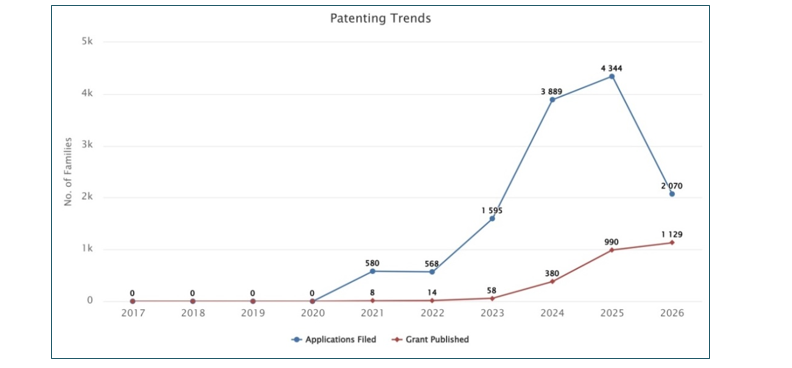
Insights: Applications filed rose sharply from 580 in 2021 to a peak of 4344 in 2025, before dropping to 2070 in 2026 (till Sep 2026); and Grants published increased steadily from 2021.
Top Assignees:
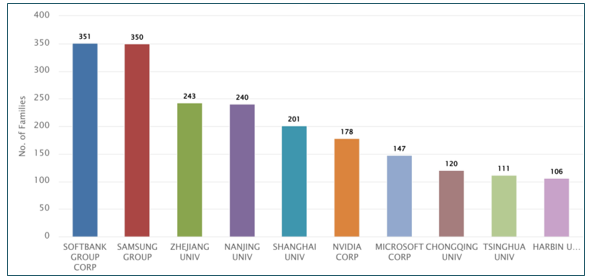
Insights: SoftBank Group Corporation (351 families), and Samsung Group (350 families) has filled the highest number of patents, followed by Zhejiang University (243 families) and Nanjing University (240 families, indicating a substantial lead over the remaining companies.
Technology Trend – Top Assignee vs. Industry
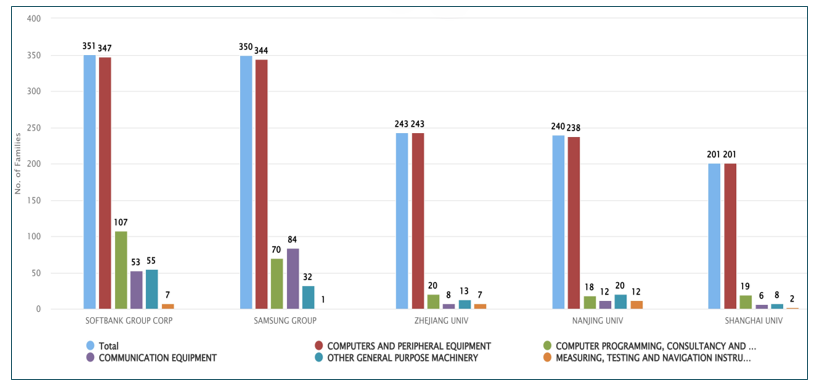
Insights: SoftBank Group Corporation and Samsung Group lead with 351 & 350 patent families respectively, followed by Zhejiang University and Nanjing University with 243 and 240 patent families respectively, with most portfolios concentrated on computers and peripheral equipment.
Geographical Landscape in Generative AI Technologies
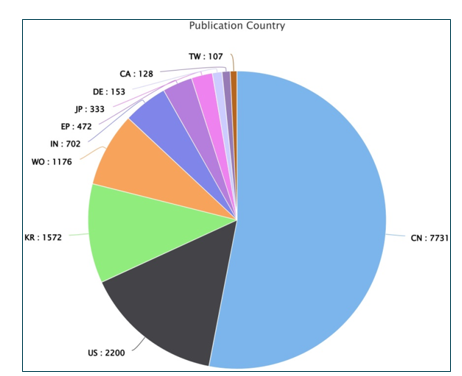
Insights: China dominates publication activity with 7731 publications, substantially ahead of the United States (2200), and Republic of Korea (1572)
Challenges and Limitations
- Rapid Technological Evolution: GenAI technologies are developing extremely quickly. Patent publication timelines can make it difficult to capture the most recent innovations.
- Patent Classification Challenges: GenAI inventions may span multiple technical areas, making traditional classification systems insufficient for accurately identifying all relevant patents.
- Overlapping Technologies: A single GenAI invention may involve multiple technologies, including model architecture, training methods, data processing, hardware acceleration, and application-specific techniques.
- Patent-Family Complexity: The same invention may appear through multiple applications across different jurisdictions. Proper family consolidation is therefore essential to avoid overstating patent activity.
- Ownership and Assignment Changes: Ownership can change through acquisitions, mergers, assignments, subsidiaries, and corporate restructuring. Identifying the current ultimate owner can be challenging.
- Difficulty Assessing Patent Quality: Patent counts do not necessarily represent technological importance. Citation activity, claim scope, family size, geographic coverage, prosecution history, and commercial relevance may need to be considered.
- Linking Patents to Commercial AI Products: Determining whether a specific patent is implemented in a commercial AI model or product can be difficult and may require detailed technical analysis.
- Rapidly Changing AI Architectures: The transition from GANs toward LLMs, diffusion models, multimodal architectures, and agentic systems demonstrates how quickly the technology landscape can change. Patent landscapes therefore require regular updates.
- Open-Source versus Proprietary Innovation: GenAI development occurs across both proprietary and open-source ecosystems. Not every technological development will result in a patent; making patents only one component of the broader innovation landscape.
Conclusion
Patent landscape analysis furnishes a systematic examination of the GenAI ecosystem through investigation of technological innovations, practical implementations, organizational participants, and regional distribution patterns. Accelerated expansion in large language models, diffusion-based architectures, cross-modal frameworks, autonomous AI systems, automated code development, and domain-tailored solutions has intensified GenAI patent filing activity, notably throughout 2024–2025. Patent analytical methodologies facilitate research and development strategy formulation, market competitive positioning, intellectual property risk evaluation, emerging technology identification, and discovery of novel commercial prospects.
How IdeationIP Can Help
At IdeationIP, we bridge the gap where AI’s speed meets human judgment. Our advanced AI tools scan global databases quickly, while expert analysts interpret results with legal and strategic precision. This ensures innovators avoid wasted filings, identify risks early, and gain actionable insights into competitor landscapes.
We provide a full suite of services:
- Prior art searches
- Novelty assessments
- Invalidity searches
- Freedom-to-operate (FTO) analysis
- Patent landscape studies
- Competitor monitoring
- Strategic IP portfolio guidance
By combining AI-driven efficiency with expert analysis, IdeationIP delivers patent research that is faster, broader, and more reliable—directly addressing challenges of scale, complexity, and accuracy.